Bush says he saw 1st plane hit on TV. How could this be. It was not aired until the next day.here is bush lying!
Flynt Leverett worked as a senior director for Middle East affairs at the National Security Council, the NSC, and he was a CIA analyst.
http://representativepress.blogspot.com/2006/12/former-cia-official-exposes-b... not youtube
The Bush Administration has committed fraud before. See background information on the fraud committed by the Bush Administration to get us into the Iraq War:
The Problem Was Not "Faulty Intelligence," the Problem Was Dishonestly Selecting And Omitting Intelligence
http://representativepress.blogspot.com/2006/02/reposted-problem-was-not-faul... not youtube
Senate Hearing on Iraq Pre-War Intelligence
http://representativepress.blogspot.com/2006/06/senate-hearing-on-iraq-pre-wa... not youtube
US Intelligence About Iraq Didn't Really Fail, It Was Manipulated
http://representativepress.blogspot.com/2005/08/us-intelligence-about-iraq-di... not youtube
Beyond all reasonable doubt, the Bush Administration is guilty of the high crime of lying our nation into war.
http://representativepress.blogspot.com/2006/04/beyond-all-reasonable-doubt.html not youtube
Read Dealing with Tehran by Flynt Leverett here: http://www.newamerica.net/publications/policy/dealing_with_tehran
not youtube
See video: Elliott Abrams is another NeoCon that doesn't respect the Constitution
http://www.youtube.com/watch?v=AeB_gIgIB9Q
US Intelligence About Iraq Didn't Really Fail, It Was Manipulated
"Never -- not once -- did it say, 'He has WMD.'" - General Zinni
"General Zinni was alarmed that day to hear Cheney make the argument for attacking Iraq on grounds that Zinni found questionable at best:
"Simply stated, there is no doubt that Saddam Hussein now has weapons of mass destruction," Cheney said. "There is no doubt that he is amassing them to use against our friends, against our allies, and against us."
Cheney's certitude bewildered Zinni. As chief of the Central Command, Zinni had been immersed in U.S. intelligence about Iraq. He was all too familiar with the intelligence analysts' doubts about Iraq's programs to acquire weapons of mass destruction, or WMD. "In my time at Centcom, I watched the intelligence, and never -- not once -- did it say, 'He has WMD.'"
Though retired for nearly two years, Zinni says, he remained current on the intelligence through his consulting with the CIA and the military. "I did consulting work for the agency, right up to the beginning of the war. I never saw anything. I'd say to analysts, 'Where's the threat?' " Their response, he recalls, was, "Silence."
Zinni's concern deepened as Cheney pressed on that day at the Opryland Hotel. "Time is not on our side," the vice president said. "The risks of inaction are far greater than the risks of action."
Zinni's conclusion as he slowly walked off the stage that day was that the Bush administration was determined to go to war. A moment later, he had another, equally chilling thought: "These guys don't understand what they are getting into." - For Vietnam Vet Anthony Zinni, Another War on Shaky Territory (washingtonpost.com)
The Bush Administration didn't care, they wanted their War on Iraq, they ignored CIA warnings. C.I.A. Warns That a U.S. Attack May Ignite Terror WOW like blowback or creating future terrorist bent on revenge for family members killed
"There have also been questions about the public portrayal of intelligence by senior policymakers. Preliminary reviews indicate that public statements did not always portray the detailed caveats about Iraqi WMD that intelligence reports generally provided. In addition, questions about possible pressure on analysts to alter their judgments and about possible suppression of alternative assessments must be a central part of a thorough and detailed review."- Opinion from Congresswoman Jane Harman representative from California, ranking Democrat on the House Intelligence Committee. WMD: What Went Wrong?
"Nuances, qualifications and caveats were dropped; a slam-dunk was the assessment relative to the presence of weapons of mass destruction in Iraq. The CIA was telling the Administration and the American people what it thought the Administration wanted to hear." - Sen. Carl Levin, D-Mich
bush laughs at no wmds in iraq
bush wanted iraq invasion day one
General Wesley Clark tells of how Middle East destabilization was planned as far back as 1991
Enough information is presented in this short video to bring the entire Bush Administration up on charges of a criminal conspiracy to deceive the American Congress into allowing an unprovoked invasion of the sovereign nation of Iraq.
Features interviews with Lieutenant Colonel Karen Kwiatkowski, Robert Jensen, Chief U.N. Weapons Inspector Scott Ritter, William Hartung (World Policy Institute), Author Tariq Ali, Yale Professor Immanuel Wallerstein, and author of "The Pentagon Papers" Daniel Ellsberg.
This clip is from a documentary that aired on BBC in 2005.
Could Bush Be Prosecuted for War Crimes?
While the United States is a country like any other, its citizens no more special than any others on the planet, Americans still react with surprise at the suggestion that their country could be held responsible for something as heinous as a war crime.
From the massacre of more than 100,000 people in the Philippines to the first nuclear attack ever at Hiroshima to the unprovoked invasion of Baghdad, U.S.-sponsored violence doesn't feel as wrong and worthy of prosecution in internationally sanctioned criminal courts as the gory, bload-soaked atrocities of Congo, Darfur, Rwanda, and most certainly not the Nazis -- most certainly not. Howard Zinn recently described this as our "inability to think outside the boundaries of nationalism. We are penned in by the arrogant idea that this country is the center of the universe, exceptionally virtuous, admirable, superior."
Most Americans firmly believe there is nothing the United States or its political leadership could possibly do that could equate to the crimes of Hitler's Third Reich. The Nazis are our "gold standard of evil," as author John Dolan once put it.
But the truth is that we can, and we have -- most recently and significantly in Iraq. Perhaps no person on the planet is better equipped to identify and describe our crimes in Iraq than Benjamin Ferencz, a former chief prosecutor of the Nuremberg Trials who successfully convicted 22 Nazi officers for their work in orchestrating death squads that killed more than one million people in the famous Einsatzgruppen Case. Ferencz, now 87, has gone on to become a founding father of the basis behind international law regarding war crimes, and his essays and legal work drawing from the Nuremberg trials and later the commission that established the International Criminal Court remain a lasting influence in that realm.
Ferencz's biggest contribution to the war crimes field is his assertion that an unprovoked or "aggressive" war is the highest crime against mankind. It was the decision to invade Iraq in 2003 that made possible the horrors of Abu Ghraib, the destruction of Fallouja and Ramadi, the tens of thousands of Iraqi deaths, civilian massacres like Haditha, and on and on. Ferencz believes that a "prima facie case can be made that the United States is guilty of the supreme crime against humanity, that being an illegal war of aggression against a sovereign nation."
Interviewed from his home in New York, Ferencz laid out a simple summary of the case:
"The United Nations charter has a provision which was agreed to by the United States, formulated by the United States, in fact, after World War II. It says that from now on, no nation can use armed force without the permission of the U.N. Security Council. They can use force in connection with self-defense, but a country can't use force in anticipation of self-defense. Regarding Iraq, the last Security Council resolution essentially said, 'Look, send the weapons inspectors out to Iraq, have them come back and tell us what they've found -- then we'll figure out what we're going to do. The U.S. was impatient, and decided to invade Iraq -- which was all pre-arranged of course. So, the United States went to war, in violation of the charter."
It's that simple. Ferencz called the invasion a "clear breach of law," and dismissed the Bush administration's legal defense that previous U.N. Security Council resolutions dating back to the first Gulf War justified an invasion in 2003. Ferencz notes that the first Bush president believed that the United States didn't have a U.N. mandate to go into Iraq and take out Saddam Hussein; that authorization was simply to eject Hussein from Kuwait. Ferencz asked, "So how do we get authorization more than a decade later to finish the job? The arguments made to defend this are not persuasive."
Charge George W. Bush with war crimes?


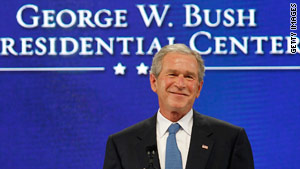
Charge George W. Bush with war crimes?
Some Bush critics have for years demanded a prosecution of the former president. They had hoped that the incoming Obama administration would put Bush on trial. No luck.
Now they have changed their focus, filing actions in foreign courts. Last week, these Bush opponents filed an action in Switzerland in advance of a Bush appearance at a charity fundraiser in Geneva.
Shortly after the filing, the Bush appearance was canceled. Bush is in no danger of going to a Swiss jail, obviously. But it's important that all Americans understand: This use of law as a weapon of politics is an assault upon the basic norms of American constitutional democracy.
- CFA ProgramsIntegrity In Wealth Management: Learn More About The CFA Program CFAInstitute.Org
- Moving to the CloudGet Best Practices with Gartner Research or call (877) 806-2599 Go.SungardAS.com
American presidents are subject to law, of course: American law.
In the case of torture -- the offense of which Bush's critics accuse the president -- the relevant law is the War Crimes Act of 1996, which provides penalties up to the death penalty for abuse of military detainees.
This law was adopted in conformity with U.S. obligations under the 1986 Convention Against Torture, which called upon all signatory states to "ensure that all acts of torture are offences under its criminal law." (It's often said that the convention "bans" torture, but that is not correct: It creates an obligation on member states to ban torture by their own nationals.)
In 2001, Bush asked government lawyers: What exactly constitutes "torture" under U.S. law? Is isolation torture? Sleep deprivation? What about putting an insect in the cell of a prisoner frightened of insects? How about waterboarding?
Bush asked those questions precisely because he wanted to comply with the law. He wanted to go up to the limit of the law, but not beyond. That's why he wished to know where the limits were found.
The legal answers Bush got -- and the methods his administration used -- have divided Americans for almost a decade. Republicans lost the 2008 election, and the Obama administration changed policy. Which is how we decide policy questions in the United States: by elections and alterations of government.
When it entered office, the Obama administration considered prosecuting the CIA officers who had done the interrogations. It seems to have considered legal action against higher-ranking officials, too. The Obama administration rejected both options.