Print
Print Email
Email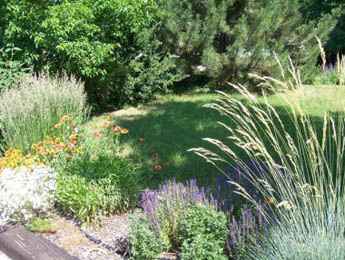
You can design a landscape that not only conserves energy but also water. Here is a brief overview of some water-conserving landscaping strategies.
Xeriscaping
Xeriscaping is a systematic method of promoting water conservation in landscaped areas. It's based on seven principles:
- Planning and design
Provides direction and guidance, mapping your water and energy conservation strategies, both of which will be dependent upon your regional climate and microclimate. - Selecting and zoning plants appropriately
Bases your plant selections and locations on those that will flourish in your regional climate and micro climate. - Limiting turf areas
Reduces the use of bluegrass turf, which usually requires a lot of supplemental watering. - Improving the soil
Enables soil to better absorb water and to encourage deeper roots. - Irrigating efficiently
Encourages using the irrigation method that waters plants in each area most efficiently. - Using mulches
Keeps plant roots cool, minimizes evaporation, prevents soil from crusting, and reduces weed growth. - Maintaining the landscape
Keeps plants healthy through weeding, pruning, fertilizing, and controlling pests.
Xeriscaping is mostly used in arid regions, but its principles can be used in any region to help conserve water.
Watering
If you can determine how much water your plants actually need, then you won't over water them and waste water. It is important to not only understand a plant's particular watering requirements, but also evapotranspiration.
Evapotranspiration is the amount of water that is evaporated from the soil and transpired through the plant's leaves. This amount of water needs to be replaced through watering. If you know your area's Et rate, you can plan the amount of water to be replaced through irrigation. Call your local water district or cooperative extension service and ask about your Et rate. However, your particular micro climate will also affect evapotranspiration in different areas of your yard.
Also, it's best to water or irrigate your plants in the early morning when evaporation rates are low. This also provides plants with water before mid-day when the evaporation rate is the highest.