Print
Print Email
Email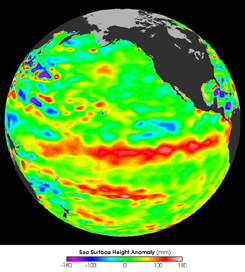
El Niño refers to the irregular warming in the sea surface temperatures from the coasts of Peru and Ecuador to the equatorial central Pacific. This causes a disruption of the ocean-atmosphere system in the tropical Pacific having important consequences for weather around the globe. This phenomenon is not totally predictable but on average occurs once every four years. It usually lasts for about 18 months after it begins.
During the 1997-98 El Niño, sea surface temperatures in the central and eastern equatorial Pacific were higher than normal. The sea surface temperature for September 1997 was the highest in the last 50 years. Also, in late September easterly winds over the equatorial Pacific between 150E and 120W decreased the most in the last 30 years.
Recent years in which El Niño events have occurred are 1951, 1953, 1957-1958, 1965, 1969, 1972-1973, 1976, 1982-1983, 1986-1987, 1991-1992, 1994 and 1997.
The El Niño of 1982-83 was responsible for the loss of nearly 2,000 lives and displacement of hundreds of thousands from their homes. The losses were caused by droughts and fires in Australia, Southern Africa, Central America, Indonesia, the Philippines, South America and India. There were floods in the USA, Gulf of Mexico, Peru, Ecuador, Bolivia and Cuba. More hurricanes than usual affected Hawaii and Tahiti.